
Institutional Compliance
& Material Integrity.
We adhere to stringent standards for laboratory infrastructure. Our systems are engineered to meet global compliance requirements, helping every installation provide a safe, precise, and verified environment for mission-critical operations.
Certifications & Standards
ISO 9001:2015
Quality Management Systems
A structured commitment to quality assurance across manufacturing and engineering processes, supporting consistent delivery of high-precision laboratory infrastructure.
ASHRAE 110
Airflow Containment Performance
Rigorous testing and validation for fume hood systems, supporting safe airflow containment in critical laboratory environments.
SEFA 8M
Laboratory Furniture Integrity
Laboratory casework engineered to demanding mechanical standards for structural load capacity and chemical-resistance durability.
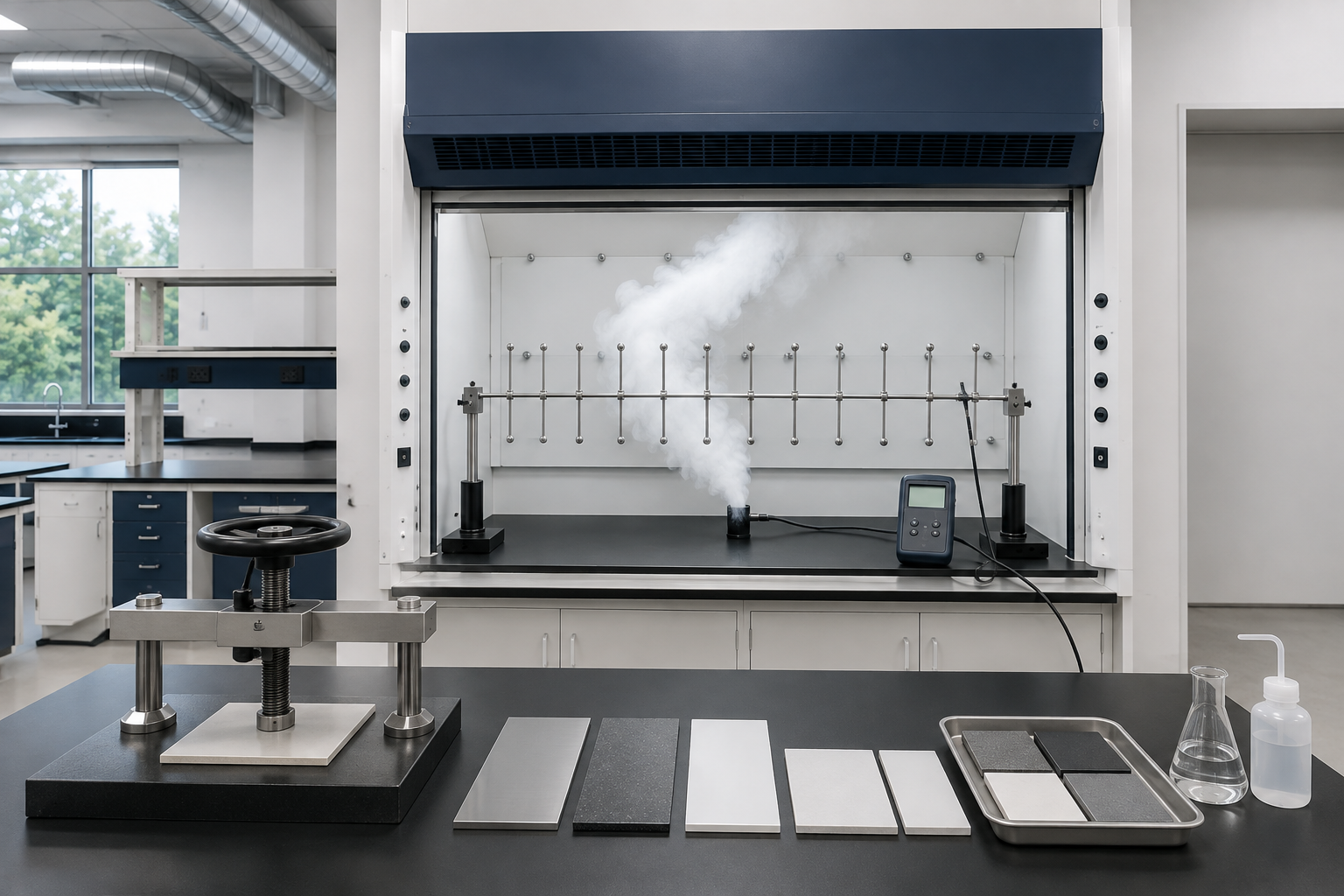
Structural Integrity &
Airflow Validation
Face Velocity Validation
Verified airflow velocities support operator protection and reliable containment.
Smoke Containment Testing
Real-world smoke visualization validates containment under varied operating conditions.
Structural Load Verification
Load-bearing components are tested to support long-term durability and safety.
Chemical Resistance Testing
Materials are assessed for resistance to corrosive chemicals and solvents.
Quality Assurance Process
Initial Feasibility &
Compliance Review
Our quality process begins with a comprehensive technical audit. Project specifications are aligned with standards such as ASHRAE 110 and SEFA so every engineered component is benchmarked against mission-critical safety requirements from the conceptual phase.
Precision Material
Verification
Every raw material—from chemical-resistant phenolic resins to high-grade industrial steel—undergoes verification. Certified sourcing and batch-consistency checks help ensure the infrastructure can withstand demanding chemical environments.
Iterative Engineering &
CAD Sign-off
Before fabrication, multiple design reviews are completed. Direct oversight from the lead mechanical engineer confirms that 3D models meet millimeter tolerances and that structural loads and airflow paths have been validated before sign-off.
Mechanical Lifecycle
Testing
Before handover, systems undergo mechanical stress and lifecycle testing. Moving parts, spigot joints, and integrated infrastructure are cycled under load to simulate extended laboratory use and verify consistent mechanical accuracy.